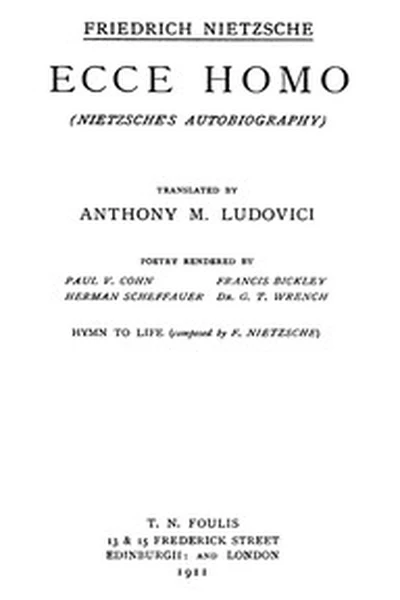
Ecce Homo: Complete Works, Volume Seventeen Summary
The Biology of Thought and the Art of Affirming Destiny
by Nietzsche, Friedrich Wilhelm
10 min read14 min audioAI summary + audio
You'll learn
- 1Suffering is not a mistake to be avoided but a physiological tool that strips away conventional illusions to reveal a higher perspective.
- 2The human intellect is a secretion of biology, meaning mental clarity is dependent on the ruthless management of diet, sleep, and environment.
- 3True strength is the capacity to digest misfortune and transform every accidental event into a willed choice.
- 4Traditional morality and selflessness are often masks for weakness and decadence used to guilt the strong into submission.
- 5The highest form of wisdom is the Dionysian affirmation of life, which embraces horror and destruction as essential parts of vitality.
- 6Liberation is achieved not by escaping necessity or pain, but by passionately loving and willing the necessity of one's own destiny.
About this summary
What if your 'goodness' is actually a mask for weakness, and your greatest suffering is the only tool capable of liberating you?
You wake up feeling a heavy, inexplicable fog in your mind.
advancedExistentialismPhilosophyPsychologyEthicsClassical Studies
What's inside
A chapter-by-chapter breakdown of the key ideas — read the full summary or listen to the narration.
- 1The Philosophy of the Hammer — An exploration of how fragility and illness can lead to dialectical clarity.
- 2The Biology of Thought — A study of the connection between physical health and intellectual power.
- 3The Dionysian Spirit — An analysis of the failure of reason and the need for exuberant affirmation.
- 4The Liberation of the Free Spirit — A critique of the scholar's discipline and the comfort of public approval.
- 5The Great Noon — A challenge to inherited guilt and the morality of the saints.
- 6The Eternal Recurrence — A meditation on the terrifying idea that every moment of existence repeats forever.
- 7The Immoralist — A dismantling of traditional goodness as a tool for the weak.
- 8The Eternal Yea — A reflection on the divine art of forgetting and the love of destiny.
What you'll walk away with
- “What if your current mental fog is not a failure of willpower, but a signal that your physical environment or biology needs adjustment?”
- “Notice when you are using the desire to be a good person as a mask to avoid the risk of being a strong person.”
Ratings & reviews
Top reviews
No ratings yet. Be the first to review.
You might also like
Philosophy & Ideas
More Philosophy & Ideas books
Trending
Popular right now





ReadOrion summaries and audio are AI-generated — condensed interpretations of the key ideas, not substitutes for the original works.
All rights to source books belong to their authors and publishers.