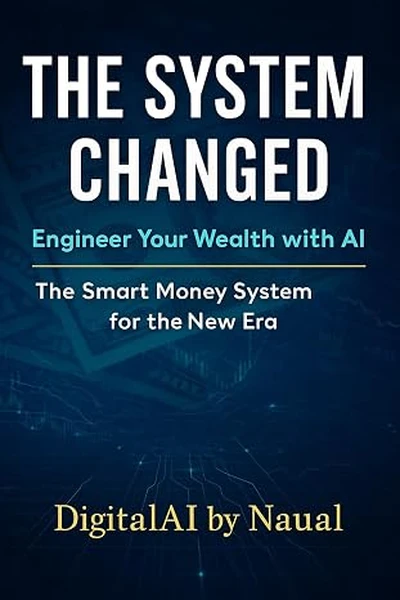
The System Changed Summary
Escaping the Modern Financial Trap and Engineering Your Freedom
by Naual Baba
You'll learn
- 1The traditional financial map of saving and patience is obsolete because inflation acts as a hidden tax that erodes labor and rewards those who borrow over those who save.
- 2True wealth is not defined by the size of your income but by the assets you own and the amount of your time you control.
- 3The gap between effort and wealth is not a personal failure but the result of a system designed to keep individuals as high quality cogs in a corporate engine.
- 4Financial literacy is a deliberate omission from formal education to ensure a compliant workforce that rents its existence rather than owning its future.
- 5AI is a cognitive force multiplier that grants individuals the same analytical power as institutional hedge funds, leveling the playing field for wealth creation.
- 6Knowledge is a dormant trait until it is converted into a scalable digital asset, transforming personal expertise into a financial commodity.
- 7Emotional detachment from market volatility is a competitive advantage that allows the wealthy to act on calculation while others react with impulse.
About this summary
Your steady paycheck is a hidden tax; the system isn't broken, it's working exactly as intended to keep you as a high-quality cog.
What's inside
A chapter-by-chapter breakdown of the key ideas — read the full summary or listen to the narration.
- 1CHAPTER 1 — THE MODERN FINANCIAL TRAP — This chapter examines the illusion of stability provided by steady paychecks and degrees.
- 2CHAPTER 2 — THE SYSTEM WAS NEVER DESIGNED FOR YOU TO WIN — This chapter explains how the economic system rewards debt and ownership over saving.
- 3CHAPTER 3 — WHY MOST PEOPLE STAY POOR (AND DON’T — This chapter discusses the psychological and educational barriers that keep people trading time for money.
- 4CHAPTER 4 — INFLATION, CONTROL, AND THE ILLUSION OF FREEDOM — This chapter analyzes how inflation functions as a silent theft of purchasing power.
- 5CHAPTER 5 — THE POWER OF AWARENESS AND FINANCIAL EDUCATION — This chapter contrasts formal schooling with the self education required for wealth.
- 6CHAPTER 6 — THE RISE OF OWNERSHIP: BUILD, DON’T BORROW — This chapter explores the strategic shift from renting skills to building assets.
- 7CHAPTER 7 — AI AND THE NEW AGE OF FINANCIAL INTELLIGENCE — This chapter discusses the democratization of financial power through artificial intelligence.
- 8CHAPTER 8 — TURNING KNOWLEDGE INTO ASSETS — This chapter explains how to package expertise into scalable digital products.
- 9CHAPTER 9 — THE WEALTH MINDSET: — This chapter addresses the emotional discipline required to navigate market fluctuations.
- 10CHAPTER 10 — THE PATH FORWARD: ENGINEER YOUR FREEDOM — This chapter provides a framework for calculating a freedom number and designing income streams.
- 11EPILOGUE — A MESSAGE FROM THE AUTHOR — This concluding section encourages the reader to discard the obsolete map of the old economy.
What you'll walk away with
- “What if the feeling of working harder for less is not a sign of failure, but a signal that the rules of the game have changed?”
- “Notice how the phrase I cannot afford it shuts down your brain, and replace it with a question that forces your mind to find a solution.”
Ratings & reviews
Top reviews
No ratings yet. Be the first to review.
You might also like
Same author
More from Naual Baba
Trending
Popular right now
Want the complete original?
This is a concise AI summary of the key ideas. For the full book — every chapter, example, and story — get the original.
Get the full book on AmazonAmazon affiliate link · supports ReadOrion at no extra cost to you
ReadOrion summaries and audio are AI-generated — condensed interpretations of the key ideas, not substitutes for the original works.
All rights to source books belong to their authors and publishers.